28 May 2008

Notes from the Glass House – yours and theirs


The Glass House sketchbook features quotes by Philip Johnson, blank pages for your own notes or sketching, and sketches inspired by the site by 29 architects, designers, and artists including: Yves Béhar, Michael Bell, Deborah Berke, James Biber, Mattia Bonetti, Constantin Boym, Seymour Chwast, Stephen Doyle, Steven Ehrlich, Rafael Esquer, Alexander Gorlin, Steven Holl, Christopher Huan, Rainer Judd, Maira Kalman, Chip Kidd, LOT-EK | Giuseppe Lignano and Ada Tolla, Mark McInturff, Richard Meier, Toshiko Mori, Michael Morris, Fred Noyes, Gaetano Pesce, Ron Radziner, Jens Risom, Yoshiko Sato, Denyse Schmidt, Alison Spear and Joseph Tanney.

All proceeds from this sketchbook will support the Glass House.

The custom edition Glass House Moleskine® sketchbook costs $25.95 can be purchased at the Glass House gift shop, or by calling 203.594.9884 - x 1. – GF

27 May 2008

Alice Ball

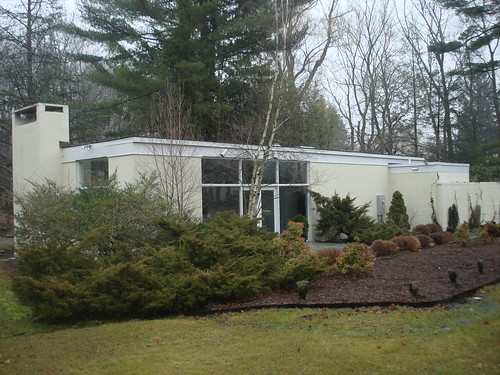
If you're interested in the fate of Philip Johnson's Alice Ball house, in New Canaan, you no doubt have already seen the Times story from Sunday and the post in Mediabistro.com (which linked to us; the Times, of course, did not, although the Times reporter spent a lot of time clicking around on our blog about two weeks ago while preparing the story).

The Times story is a rehash, although it does manage to get one important fact wrong: it cites as an example of modern houses commanding steep prices the sale of Neutra's Kaufmann house not long ago. But I read in the Times the other day that the sale did not go through; the anonymous buyer has either backed out or couldn't come up with the money or something, it wasn't clear (in fairness to the Times reporter, the Alice Ball house story was in a section that goes to press earlier in the week, and the news about the Kaufmann house sale might have come out afterwards).

Mediabistro.com isn't quite as kind to Cristina Ross, the owner of the house, as we have been, and I find the snarky style of the writing to be off-putting, but here's the post (which, by the way, uses our photo, which is fine -- we put it on Flickr and we ourselves rarely feel any compunction against using other people's photos). -- ta

16 May 2008

Chilean Sampler


Perhaps the thing most important to me about any house or building, whether modern or ancient, is how it interacts with its immediate environment. I grew up in a neat little modern house that I was so proud of for its integration into the landscape: its grey cypress wood exterior and single story low profile gave it the appearance of being just another outcrop of the ever-present rockledge Pound Ridge is notorious for. It just makes sense that a dwelling respects the features of the land it occupies as opposed to appearing uncomfortably perched as if its placement is only temporary.

I keep an eye open for interesting architecture out of South America, (probably in a subconscious effort to offset my usual Eurocentric-ness), and this morning I bumped into the terrific Chilean architectural photography site called BARQO – banco fotográfico de arquitectura chilena. Poking around through the Vivienda Unifamiliar sections, not only did I long to understand Spanish, but I began to think about the relationship between exceptional places the exceptional architecture that is created in those places. Some houses are designed to blend in either by color, by texture or by shape - or a combination of those qualities. Some, however, are successful because they celebrate the physical environment they exist in by being radically different. Here are some examples from Barqo (bARCo as it appears on the site), which I found through Judit Bellostes, which is also very worthy viewing. – GF


1. Casa Las Palmas · Sebastián Irarrázaval, Guillermo Acuña
FOTÓGRAFO Guy Wenborne

2. Chalet C-6 · dRN arquitectos
FOTÓGRAFO Max Nuñez

3. Casa Muelle · Jonas Retamal
FOTÓGRAFO Stefan Bartulin Cortese

4. Casa Dos Robles · Aguilo Pedraza

5. Asadera y Mirador · Carolina Contreras y Tomás Cortese
FOTÓGRAFO Alvaro Benitez

6. Casa Omnibus · Gubbins Arquitectos
FOTÓGRAFO Marcos Mendizabal / Pedro Gubbins

15 May 2008

Next House: Prefab that fits all

I really like some of the things I see on Next House's site. I even like the site itself, which is really saying something; I find so many architects’ sites so fussy and difficult to navigate, which is odd given the inevitable descriptors in their “about us” statements: elegant, functional, minimal, clean, etc. I love that the flat-pack houses come in sizes XS, S, M, and L. – GF
(via Below the Clouds)

14 May 2008

Neutra's Kaufman House Sells for $16.8 Million


In the leafy suburbs of Connecticut, Stone's Celanese House sold for $4.1 million. But in the California desert, Neutra's Kaufman House sold for much more -- $16.8 million. Christie's sold it, along with a trove of paintings. The Times reports:

Considering that a painting went for more than $50 million, the Kaufmann House, in Palm Springs, Calif., a 1946 Modernist landmark in glass, steel and stone designed by the architect Richard Neutra, was a veritable bargain. It was being sold by Brent Harris, an investment manager, and Beth Edwards Harris, an architectural historian, who are divorcing.

The home, which was originally commissioned as a desert retreat by Edgar J. Kaufmann, the Pittsburgh department store magnate for whom Frank Lloyd Wright built Fallingwater in Pennsylvania a decade earlier, met its low $15 million estimate (or with commission, $16.8 million).

After the sale, Marc Porter, Christie’s president in America, said the buyer, whom he declined to name, exercised an option to purchase an orchard adjacent to the property for an additional $2.1 million that includes three cacti that were a present from Frank Lloyd Wright to Mr. Kaufmann on his first visit to the home.

It isn’t the first time a Modernist house has been sold at auction. Over the years both Christie’s and Sotheby’s have offered such architecturally important dwellings as Mies van der Rohe’s Farnsworth House and a 1950 town house on East 52nd Street that Philip Johnson designed as a guest house for Blanchette Rockefeller, the wife of John D. Rockefeller III.

I borrowed the photo, above, from Flickr. -- ta

12 May 2008

It's a Deal for Edward Durell Stone's Celanese House

Really good news for modern house aficionados out of New Canaan today: The deal for the Celanese House closed. Joel Disend, an executive at New York Life, bought it for $4.1 million, half-a-million below its last listing price.

I say good news because we can only assume that Disend bought the house, which Edward Durell Stone designed, to live in rather than to tear down. It's an oddity outside, no doubt, but stunning inside. We loved it when we saw it, unfurnished, during New Canaan's Modern House Day in November. Except for its price, which was almost $4 million above what we could afford, and its location, on Oenoke Ridge Road, which is too main street for us, we might have bought it ourselves.

But its good news too for Jackie and Bruce Capra, New Canaan residents who bought the house because they didn't want to see it torn down (they had seen that happen too many times to modern houses in New Canaan), invested in the renovation and now, presumably, will get a payoff for their effort (Fred Bernstein wrote a good account of the Capras in the Times, here).

There's also lots of background information on this blog and on my other blog, Sphere. -- ta

07 May 2008

Modern Sewage Treatment

In one of my other lives, I write about Long Island Sound, where pollution and improvement to sewage treatment plants is a big issue. New York City is investing tons of money to fix its treatment plants, four of which sit near the far western end of the Sound. A bit farther west, in Brooklyn, the city is upgrading its Newtown Creek plant. The Times published this terrific picture of it today. -- ta

05 May 2008

Stone's Celanese House on the Verge of Being Sold

While maneuvering continues about the fate of the Alice Ball House, two doors away on Oenoke Ridge Road in New Canaan, Edward Durell Stone's Celanese House is on the verge of being sold. Contracts have been signed; the closing is still to come.

Of course anything can happen between signing of the contracts and the closing, but it looks as if the Celanese House, a real gem inside and a conversation starter if nothing else on the exterior, will be bought. The listing was for $4.9, so if the final price is anywhere even near that, it won't be a teardown. There's background here and here.

More Maneuvering in the Quest to Protect the Alice Ball House

alice ball house front and side A settlement of a lawsuit between the owner of the Alice Ball House, which Philip Johnson designed, and the Town of New Canaan has been scuttled by neighbors of the Alice Ball House who don’t want to see the part of the property near them developed.

(I’m paraphrasing much of this from a very hard-to-understand story in the New Canaan Advertiser, here.)

The decision by the neighbors – William and Linda Powell – means that Cristina Ross, the owner of the Alice Ball house, will reapply to do exactly what the Powells don’t want: namely, to build a house behind the Alice Ball house and convert the Alice Ball House into its pool house.

Presumably if Ross applies to the Town, and specifically to the Town’s environmental commission, to build what they agreed to in the court settlement that the Powells’ scuttled, the Town will approve Ross’s application.

Now bear with me here. This is fairly convoluted but I’ll try to get the background right: Ross applied to build a house on her property behind the Alice Ball House. The environmental commission said no, so Ross filed a lawsuit appealing the decision. The Powells live behind the Alice Ball House and as adjoining neighbors, they had the right to join the lawsuit on the side of the town.

Ross and the Town subsequently agreed to settle the suit. But it takes three to tango, and without the Powells’ signature, the court was not able to approve the settlement.

So essentially the Powells are forcing her to go through the process again. Presumably they are hoping that Ross, knowing that the Powells will appeal if the Town approves the application, won’t want to spend the money or the time defending the appeal.

Or perhaps they’re hoping that if they continue to stretch out the process, a buyer will come along who wants to preserve the Alice Ball House but not build near the Powells.

Ross probably would prefer that too, but thus far there are no buyers. In the meantime, her permit to demolish the house is still valid, I think. I'm told, by the way, that the Alice Ball House has been rented for the next three months, so it won't be coming down any time soon, if indeed that's still a real threat.

There's plenty of background on this issue here. -- ta

03 May 2008

I can't stop thinking about this house

Eggleston Farkas Architects in Seattle designed the Methow Cabin which I first saw on wonderful below the clouds. I just can't get it out of my head! – GF

02 May 2008

The Cape Cod Modern House Trust

The town of Wellfleet, MA, voted to give $100,000 toward restoration of a Modern house, one of 17 that The National Park Service owns there but doesn't have the money for their upkeep.

The Cape Cod Modern House Trust, which promotes the documentation and preservation of significant examples of Modernist architecture on the Outer Cape, wants to use the money to restore what is known as the Kuegel/Gips house with the hope of eventually preserving more.

The Kugel/Gipps house was designed by Charlie Zehnder who built over forty highly original houses, all on the Outer Cape. He also was one of the prime movers behind building the local drive-in movie theater on what was once an asparagus field . . .

The web site’s overview explains how this concentration of little Moderns came to be: In the late 1930s, on the isolated ‘back shore’ of Wellfleet, a group of self-taught architecture enthusiasts began building experimental structures based on the early Modern buildings they had seen in Europe. Through mutual friends they invited some of the founders of European Modernism to buy land, build summer homes and settle . . . In the three decades that followed, these architects built homes for themselves, their friends and the community of internationally influential artists, writers, and thinkers that took root nearby. Though humble in budget, materials and environmental impact, the Outer Cape’s Modern houses manage to be manifestos of their designers' philosophy and way of living, close to nature, immersed in art and seeking community.

I liked reading the bios of the architects who built on the Cape, and the section called “others” which has stuff like, “Serge Chermayeff and Aero [Saarinen . . . you knew that] were sometimes seen rowing a small boat around Slough Pond with a rock and string, making a chart of the bottom and arguing about architecture.”

In addition to the predictable but necessary plea for monetary donations, the CCMHT is also seeking drawings, photographs and narratives – even in the form of loans – pertaining to these buildings to digitize and archive for future scholarship and publication. Donations of art and furnishings connected to mid 20th century modernism on the Outer Cape, however modest, are also being sought to recreate environments in the renovated houses.

We'll try to keep up on this as it would be a nice summer excursion:
the CCMHT, in collaboration with Truro Center for the Arts at Castle Hill, will be hosting a Modern House Tour in August 2008. – GF

photos from the top: Jack Phillip's Bug House -
Photo courtesy of Florence Phillips; Charles Zehnder's Kugel/Gipps House, photo by Mark Walker; Breuer's Wise House - Avery Architectural and Fine Arts Library, Columbia University, NY, NY, photo by Joseph W. Molitor

A Modern Story from Dallas

There's a terrific story in the Dallas Morning News about a modern architect named Harold Prinz and his wife, Jeannette, and the future of the house the built in 1950, now that he's dead and she's 86. I like it because it's really a sweet love story about a couple who worked together on every aspect of their living situation, even though he was an architect and she wasn't. They shared the same modernist sensibility and persisted until they got the house they wanted.

In a way it reminds me of my in-laws, who were exact contemporaries of the Prinzes, similarly steeped in modernism and collaborated on their house here in Pound Ridge, even though neither were architects. Here's what the reporter says about the future of the Prinz house:

In an age of bulldozers and zero-lot-line McMansions, what will happen to this one-of-a-kind home?

"Regardless of its pedigree, the Prinz residence could turn into a teardown scenario," warns Peabody. "The very fact this is a midcentury home, of smaller proportions than most, makes it more of a target for an insensitive renovation or demolition."

One of Prinz's contemporaries shares Peabody's concern.

"O'Neil Ford once told me there will come a day when you outlive some of your buildings. He was absolutely right," says semi-retired architect Ralph Kelman, now in his 70s, and best known for his design of the Hilton Inn (now Hotel Palomar) and Willow Creek shopping center.

"Things are more flamboyant now," says Kelman. "I think midcentury design was, comparatively, more honest."

It's an ideal description for the Prinz home, and a quality Jeanette hopes someone else will appreciate about her husband's design.

"It's time to let this place go and let someone else love it," Jeanette says. "I just hope they don't paint over my redwood walls."

One interesting aspect of the tale is that the Prinzes wanted financing from the Federal Housing Authority, but the FHA wasn't interested in anything but a conventional house. The reporter writes:

The FHA had four chief complaints against Prinz's design for his Oak Lawn Heights residence:

1. The lack of windows on the west-facing front of the house

2. The large expanses of uninsulated plate glass

3. The nonconventional heating system

4. The unlevel lot

Ironically, all of the elements the agency cited as not fitting in with the era's design standards were the very components Prinz used to make the house literally fit in to its site and region.

The west-facing front – red brick wall, solid and demure – was designed without windows to avoid interior heating from the afternoon sun.

Conversely, large expanses of glass on the home's south and east walls beckon in the rays, open views to the side garden and lush ravine out back, and help warm the home with sunlight in winter.

The dramatic windows in the living room stretch to the ceiling rafters and follow the peak of the high-pitched roof. Plate glass works fine here, thanks to strategic overhangs, which help to moderate the elements. ...

I also commend the Dallas Morning News for its use of photos (I'm sure my commendation will make their day). I've complained a lot about how lame newspapers can be: over and over they write about modern architecture and include no picture. The Dallas Morning News created a slide show of a dozen black and white photos from the 1950s, here (photo 6 caught my eye because of the Jens Risom chairs).

The story also includes a link to PreservationDallas.org. One of our loyal readers is in the Dallas area. Maybe he can do a drive-by of the Prinz house and tell us what it looks like in 2008. -- ta