We’re
interested enough in Edward Durell Stone to borrow the new book about
him, by his son, Hicks Stone, from the library and to flip through it,
which I started to do last evening, although speaking for myself I’m
probably not interested enough to read it all. Stone was a big architect
who designed major buildings all over the world, and I’m much more
parochial. I’m interested in his houses and, in particular, those that
are near where we live.
Stone
was a celebrity. His picture was on the cover of Time magazine in 1958,
and his divorce from his second wife was on the cover of the Daily News
in 1966 (“BEAUTY SETTLES FOR A MILLION. Mexican Divorce Splits
Stones”). His major works, like the Museum of Modern Art, made him a
presence in New York City but he’s also a presence here in the northern
suburbs as well.
The
Celanese House, from 1959, is easily visible to anyone driving along
Oenoke Ridge Road in New Canaan. He designed a similar house in North
Salem, New York, for the grandfather of a friend of Gina’s and which,
coincidentally I happened to visit 15 years ago when a subsequent owner
was auctioning off all his possessions.
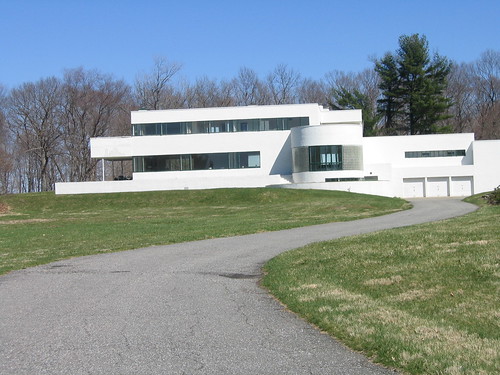
His
Mandel House, up the road from the train station in Bedford Hills, New
York, is on the National Register of Historic Places. It’s at the end of
a long driveway and not visible from the road; about five years ago,
when it was empty and on the market, I drove up and snapped the picture
above.
It
seems as if Stone designed seven houses in Westchester County (and at
least one that he designed but was not built). Here’s what Hicks Stone
wrote (page 55):
Stone’s work on the Mandel House led to another residential commission in Mount Kisco, for Ulrich and Elizabeth Kowalski. This house was more in keeping with the tenets of the International Style curvilinear element of the Mandel House was replaced by a more subdued curvilinear volume containing a spiral stairway that was faced with glass block. There relationship of the rooms and common area suggests an emphasis on functionality and the spare use of interior space. The influence of Mies van der Rohe’s Tugendhat House, which Stone may have seen when he visited Brno, Czechoslovakia, on his Rotch scholarship, was evident in the volumetric massing, fenestration, and detailing of the home, particularly that of the rear facade. Apparently the town was upset by the work, and Stone remarked that local zoning regulations were instituted as a result of the house to prevent architecture of the sort from reoccurring.
Both
the Mandel House and the Kowalski House are listed as being in Mount
Kisco, but neither actually is. They are in parts of adjacent towns that
are (or were) served by the Mount Kisco post office and therefore have a
Mount Kisco address. The Mandel House is in the Town of Bedford; the
Kowalski House is in the Town of New Castle (the same town as Bill and
Hilary, and Andrew Cuomo). So it must have been New Castle that changed
its zoning rules to prevent modern architecture from reoccurring
(although that story sounds apocryphal to me).
Here are his other Westchester houses:
1947. Seymour Kimmel House, Larchmont (although this Triangle Modernist Houses website says it might be in New Rochelle, under the same post office principle that the Mandel and Kowalski houses are in Mount Kisco).
1948. Robert L. Popper House, White Plains (razed and replaced by five houses).
William S. Rayburn House, White Plains
1949. David Stech House, Armonk.
1959. Carlo Paterno House, North Salem
Stone
also had a hand in the Verrazzano Narrows Bridge, which I didn’t know,
and, in 1946, designed the Rhinebeck Central School in partnership with Moore and Hutchins, the architects who designed our house, but I don’t think it ever got built.
Hicks
Stone’s book, by the way, is called Edward Durell Stone: A son’s untold
story of a legendary architect. It’s published by Rizzoli and is well
worth spending a couple of hours with. Hicks Stone was on the Leonard
Lopate radio show in December; you can find a recording of the interview
here. -- TA